The Client Engine | Get Found
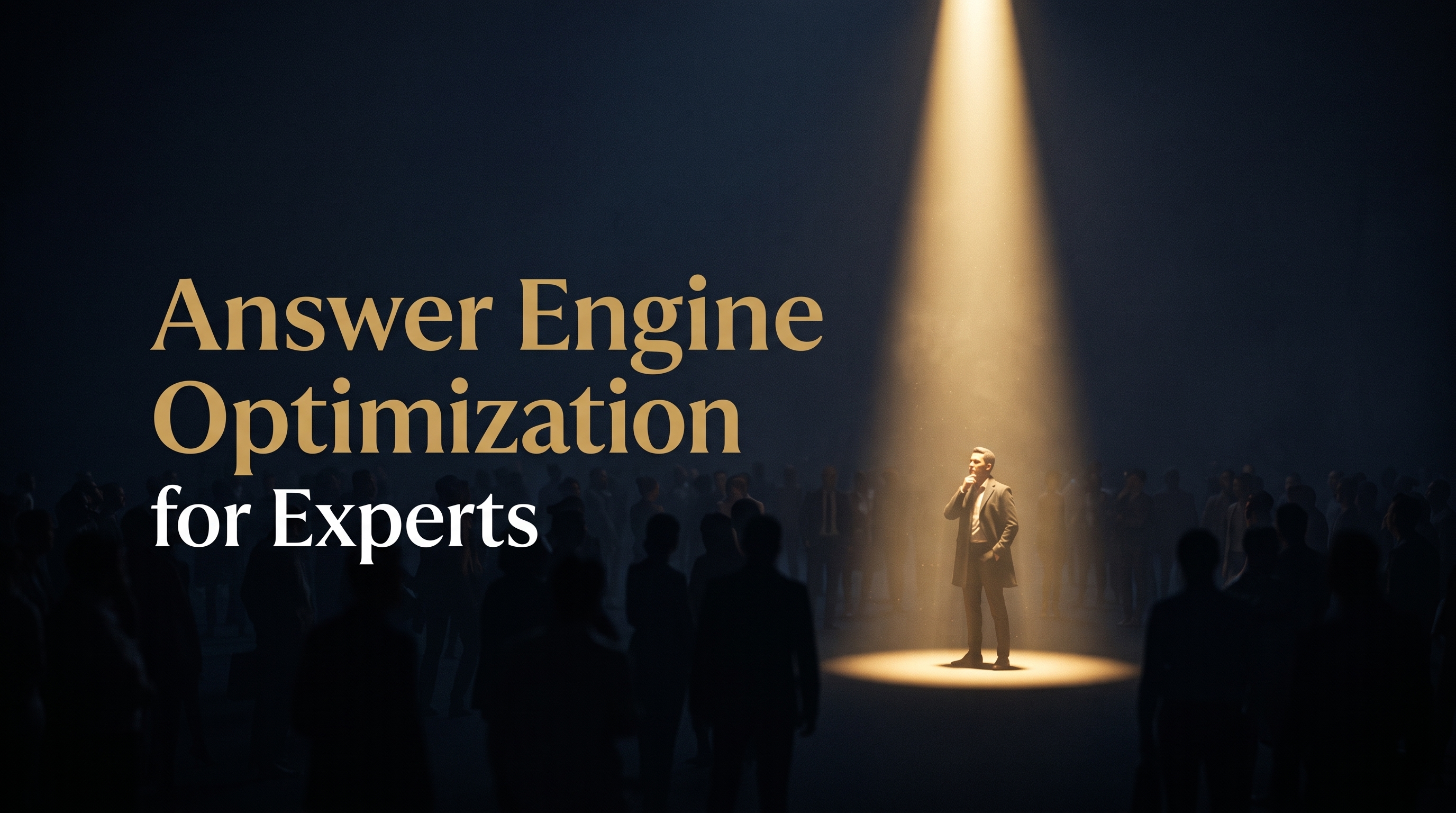
Answer Engine Optimization for Experts: How to Become the Name the Machine Says When Your Buyer Asks
The Marine Corps trained me to tell its story so clearly that anyone could repeat it right. That's the whole job now, because the one repeating your story to your buyer is AI.
The short answer: answer engine optimization (AEO) is the work of becoming the clear, trusted, quotable source that ChatGPT, Perplexity, Gemini and Google's AI Overviews reach for when someone asks a real question in your field. My view: AI doesn't reward the expert who publishes the most. It repeats the expert who's easiest to repeat correctly. When it works, AI hands back your name, often before a single link loads.
That point of view isn't the one the AI-search vendors sell. As I wrote in my book Creators, "Simplicity is scalable." ChatGPT proves it every day.
OpenAI said in November 2025 that more than 800 million people use ChatGPT every week. That's one tool, before you count Google's AI Overviews, Gemini, Copilot or Perplexity.
Going from a list of links to one name sounds like a small shift. It isn't. It's a shift in who holds the power in the exact moment a buyer decides who to trust. And if you're a coach, consultant, expert, or service provider who's been getting by on referrals and word of mouth, it's about to decide whether your pipeline fills or goes dry. So let's walk the whole thing, slowly and in plain language, because almost nobody's explained it to you without wrapping it in robes and selling it back to you as sorcery.
The game changed, and nobody sent you the memo
For twenty years the deal was stable and knowable. You, or someone you paid, published pages. Google ranked those pages. People scrolled a list, clicked a few, and some of them called you. A whole industry grew up teaching good people how to climb that ladder, keywords and backlinks and meta tags, the whole grind. It was tedious, but if you played long enough you got found.
Then the ladder got moved while everyone was still climbing it. Your buyer stopped scrolling ten links. Now they open a chat window, type one honest question in their own words, and read the single answer AI gives back. They don't visit page one. They often don't visit any page at all. They get a name, a short list of two or three, and they act on it. The whole middle of the old process, the browsing, the comparing, the clicking, collapsed into one answer, and you were either inside that answer or you were invisible, and you had no say in the moment it happened.

Here's the part that costs you money. This is happening right now, about you and your competitors, dozens of times a day, and you'll almost never see it. There's no notification when ChatGPT recommends someone else. There's no bounce report for the buyer who asked, heard a different name, and booked them instead. The old game at least let you watch your rankings climb and fall. This new game doesn't show you the list at all.
That AI, the one deciding who gets named, isn't a villain and it isn't a person. It's a system. And for most skilled, honest, heads-down experts, it's just the newest version of the same old search that's sorted you to the back of the line for years, the one that rewards the loudest and the most-marketed over the most competent. AEO's how you stop getting sorted and start getting chosen.
So what is AEO, in human
Strip off the acronym and AEO is the oldest job in my old trade: say one true thing so plainly that whoever repeats it can't get it wrong. That's the entire thing. Old SEO got you a listing. AEO gets you a recommendation. A listing is a maybe, something a buyer has to go evaluate against nine others. A recommendation is nearly a done deal, because almost nobody argues with a trusted name handed to them by something they trust. One is a spot on a page. The other is the answer itself. That's the whole prize, and it's winnable by exactly the kind of person who usually loses on volume. You'll also hear this called GEO, and what generative engine optimization is gets its own page. The goal is the same: be the source AI repeats.
Notice what AEO is not. It's not posting more. It's not louder. It's not a content treadmill or an ad budget. The answer engine isn't counting how often you shout. It's deciding whether you're clear enough, consistent enough, and corroborated enough to stake its own credibility on by saying your name out loud.
How answer engines actually decide who to cite
You can't win a game whose rules you refuse to learn, so let's name them. When an answer engine responds to a question in your field, it isn't flipping a coin and it isn't purely ranking the highest bidder. It's reaching for the sources it's learned to trust on that exact topic, and it builds its answer the way a careful, well-read person would if they'd read most of the internet and wanted to give advice they wouldn't be embarrassed to stand behind. A handful of forces decide who it reaches for, and if ChatGPT is the one you care about most, I break down how ChatGPT decides who to name on its own page.
Clarity. AI can only quote what it can cleanly understand. If your answer to a real question is buried, hedged, or wrapped in fluff, you get passed over for the source that stated the thing plainly, up top, in one clean line. A muddy river and a clear one both hold water. Only one lets you see the bottom, and AI picks the one it can see into.
Structure. Say the answer first, plainly, right at the top. An answer engine reads like a busy executive, it wants the point before the poetry. Clean headings, direct answers, a real set of questions and answers, and the behind-the-scenes markup that labels what it's looking at. Make yourself stupidly easy to quote, and you will be.
Consistency. AI trusts a source that says the same clear thing about itself everywhere it shows up. When your site, your profiles, your content, and the places others mention you all tell one coherent story, its confidence in you climbs. When the story's scattered, confidence stays low, and low confidence means it reaches for someone else.
Corroboration. AI weighs whether the rest of the web backs you up. Not just what you say about yourself, but whether other credible places say it too. It's the modern version of a reference check. You want AI to find your claim about yourself and then find it echoed somewhere that isn't you.
Read those four again and notice something. None of them are hacks. They're the same things that earn trust between two human beings. That's the good news buried in this whole shift, and we'll come back to it.
Be the name that comes back
AI can only name who it can find. The free masterclass shows what it takes to become the expert it names, step by step. About 30 minutes.
Show me how to be the answer
Old SEO vs AEO, side by side
If you've spent money on SEO, you need to see clearly where the ground moved, because some of your old instincts will now hurt you. The short version is below. For what to keep from SEO and what to stop, read the full SEO vs AEO comparison.
| Old SEO | AEO |
|---|---|
| Goal: rank a page in a list of links | Goal: be the answer AI cites by name |
| Buyer scrolls, compares, clicks | Buyer asks once, acts on the answer |
| Wins on keywords and backlinks | Wins on clarity, structure, and trust |
| Being loud helps | Being trusted is the whole thing |
| Success = traffic to your site | Success = getting recommended, often with no click at all |
| You could fake authority for a while | Faked authority falls apart under corroboration |
That last row's the one most people miss. In the old game you could manufacture the look of authority and ride it for a while. In this one, AI cross-checks you against everything else it knows. That's bad news for the loud and the hollow, and the best news in a decade for the quietly excellent. For the companion pieces, read how to get recommended by ChatGPT and SEO vs AEO, what changed and what to do now.
The problem was never your talent
Now the part the old industry won't say out loud, because your confusion is what it sells: the next program, the next agency, the next tool. You were told that if you just got good enough, and showed up long enough, you'd get found. You believed it, because it sounded fair and because you're the kind of person who does the work. But it was never the whole truth. Getting found was never only about being good. It was about being legible to whatever system was doing the sorting, and nobody taught you that part, because the people who knew it were busy selling it.
So read this slow. Your invisibility isn't a talent problem. Getting found is a practice, and most experts stop before they've run it long enough to get good at it. The game was built before the rules changed, and it benefits from skilled people staying busy, staying dependent, and staying quiet. The fix isn't more talent. It's a different model from the one you inherited, the one that told you to keep your head down and let the work speak, in a world where the work can't speak if AI has never heard of it.
When I left the Marine Corps in 1999, Sergeant Major E. A. Ybarra put this in his letter of recommendation: "Nobody had to tell him how to tell the Marine Corps story, he just did it and he did it superbly." Telling a story so clearly that someone else repeats it right is the whole of AEO. The only thing that changed is who does the repeating. Now it's AI, and it's talking to your buyer.
Invisibility isn't proof you aren't good enough. It's proof of a practice you haven't run yet.
How you become the cited source, at altitude
Here's the redesign, and it starts with a warning from Creators. The fastest way to vanish from an AI answer is "trying to be everything to everyone and ending up being nothing to anyone." AEO isn't a trick you run once and forget. It's a way of governing how you show up, on purpose, so AI and the market arrive at the same conclusion about you. There are four principles, and almost everything else is detail hanging off of them.
1. Nail the one line
Write the single sentence that says exactly what you're the one true answer to, then cut every word that isn't carrying weight. Who you help, with what, and what makes you the obvious choice. If a stranger can't repeat it back after one read, ChatGPT can't either, and neither will recommend a blur. Experts lose here constantly, because being good at a lot of things tempts you to claim all of them, and a scattered signal reads as no signal.
2. Answer the real questions, out loud, up top
Take the exact questions your buyers ask right before they hire, the ones you've answered a hundred times on calls, and answer them cleanly where AI can read them, with the plain answer in the first two lines. Not clever. Not keyword-stuffed. Clear. Each honest answer's a brick in your authority, and the pile of bricks is what AI learns to trust and quote.
3. Put your proof where it can be seen
AI, like a buyer, weighs proof. Real work, real outcomes stated honestly, the story that holds up under a second look. Trust's the currency of this whole system, and currency has to be visible to spend. Proof you keep private, buried three clicks deep like you're ashamed of it, might as well not exist.
4. Build a consistent, structured footprint you own
Keep your name, your focus, and your story identical everywhere you show up, and give AI clean structure to read, headings, a real FAQ, labeled markup. Then house it on ground you control, a home base that's yours, so your authority compounds and keeps getting found long after you hit publish. Rent all your presence on platforms you don't own and the ground can shift under you again. Owned ground doesn't.

Notice what these four aren't. They aren't loud. They aren't manipulative. They're the mechanics of earning trust, written down and done on purpose. That's the good news I promised you. The loud, mediocre crowd can't follow you here, because being clear requires actually being good and being trusted requires actually delivering. You can fake your way to a viral post. You can't fake your way to a recommendation.
What this looks like in the real world
Picture two experts in the same field, equally skilled. The first keeps doing what worked in 2015. A decent website, a few blog posts written for keywords, a reliance on referrals. When a buyer asks ChatGPT who to trust, it's got almost nothing clear to go on, so it reaches for someone louder. The first expert never finds out it happened.
The second spends a season nailing one clear line, answering the real questions plainly up top, putting honest proof where it can be seen, and keeping it all consistent on ground they own. When the same buyer asks ChatGPT the same question, it now has a clear, structured, corroborated source to reach for, and it reaches for the second expert by name. Same skill. Completely different outcome. The only difference was that one became legible to the system and the other stayed invisible without ever meaning to.
The scoreboard nobody else is measuring
Most AEO dashboards count the wrong thing. Traffic. Impressions. Vanity reach that feels like progress and pays no bills. Let me give you the scoreboard that actually matters, because if you win this game the right way, the win shows up in more places than your bank account.
When you become the answer, the right clients arrive already half-sold, because the answer vouched for you before you ever said a word. Your calendar stops being a scramble for the next lead and starts holding margin. You stop chasing, and when you stop chasing you get back something the old grind stole: your evenings, your attention, the room to be present with the people you were building all of this for in the first place. More in the business, and a better balance sheet in the life around it. That's the full win, and it's the one the old game never thought to put on the board.
This isn't grind culture with a new sticker on it. It isn't shouting louder than everyone else or gaming AI with tricks that stop working the moment they're discovered. It's the opposite. It's becoming so clearly the trusted answer that getting chosen stops being a fight you win from scratch every month and becomes a discipline you run, the most boring part of your week.
What waiting actually costs you
You can be the best consultant in your field. If the answer names someone else, none of that skill ever reaches the buyer. The person who asks ChatGPT this afternoon and hears a competitor's name doesn't come back around next quarter to give you another chance. In most cases you'll never even know they existed, and they'll never know you did. The sale happened in a room you weren't in, decided by whether you'd done the work to be the answer before the question got asked.
This isn't a race, and it isn't luck. Client acquisition is a utility, not a mystery. At Hyundai Capital America I ranked number one nationally across all 9 core KPIs for 15 of 24 months. That isn't a hot streak. It's a boring system, run every month. Being the answer works the same way: one clear line, the real questions answered, the same story everywhere, kept up after most people stop.
The free masterclass walks those steps in order, starting with the one line you want to be known for, until you're the source AI reaches for. ChatGPT will repeat somebody's one line tomorrow. Make it yours, and start with the masterclass. Lead your power.
Be the source it cites by name
AI can only repeat what you made simple enough to repeat. In the free masterclass, How to Become the Answer in Your Market, I walk through the 5 Shifts and the 4-step Client Engine that make your one line the one it repeats.
Make me findableThe questions people actually ask me
Is AEO just the new name for SEO?
No. They overlap, but the target's different. SEO aims to rank a page in a list of links. AEO aims to be the answer AI cites by name, which rewards directly and honestly answering real buyer questions over stuffing keywords. You can be strong at one and invisible in the other, which is exactly why so many experts with "good SEO" are disappearing from AI answers.
Do I have to post every day or run ads to do AEO?
No. AEO runs on clarity, structure, and real proof, not volume or ad spend. A clear, credible, well-structured presence can get cited without you chaining yourself to a content calendar or burning cash on ads you hate running. The work is sharper, not heavier.
Can I really influence what an AI says about my field?
You can influence whether you're a clean, quotable, trusted source on your topic, which is exactly what these engines look for. There's no guaranteed placement, and anyone promising you one is selling a story. What reliably moves you toward being the name that gets cited is clarity, consistency, and corroboration over time. Individual results vary.
How long does AEO take to work?
It's a compounding effort, not a switch. Each clear answer, each consistent signal, each piece of visible proof adds to what AI knows about you, and the effect builds. Anyone handing you a specific date is guessing or selling. The experts seeing movement are the ones who started before it was obvious.
I'm not technical. Is this something I can actually do?
Yes. The core of AEO isn't code, it's clarity: answering real questions plainly, saying one consistent thing about what you do, and putting honest proof where it can be seen. Those are things you already do in a conversation. AEO's just doing them on purpose, in public, in a structure AI can read.
Is this only for tech or online businesses?
Not even a little. AI is recommending consultants, coaches, therapists, fractional CFOs, and local service businesses, not just software. If your buyers ask about your field, this applies squarely to you.